Turn the sword around
Think of the old habit of turning a character in place to see a new weapon properly. The blade caught your attention, but the handle was there every time the character stood still. White HwanDoo rewards that second look. Its name offers a route from a familiar inventory image to a small, distinctive part of real sword history.
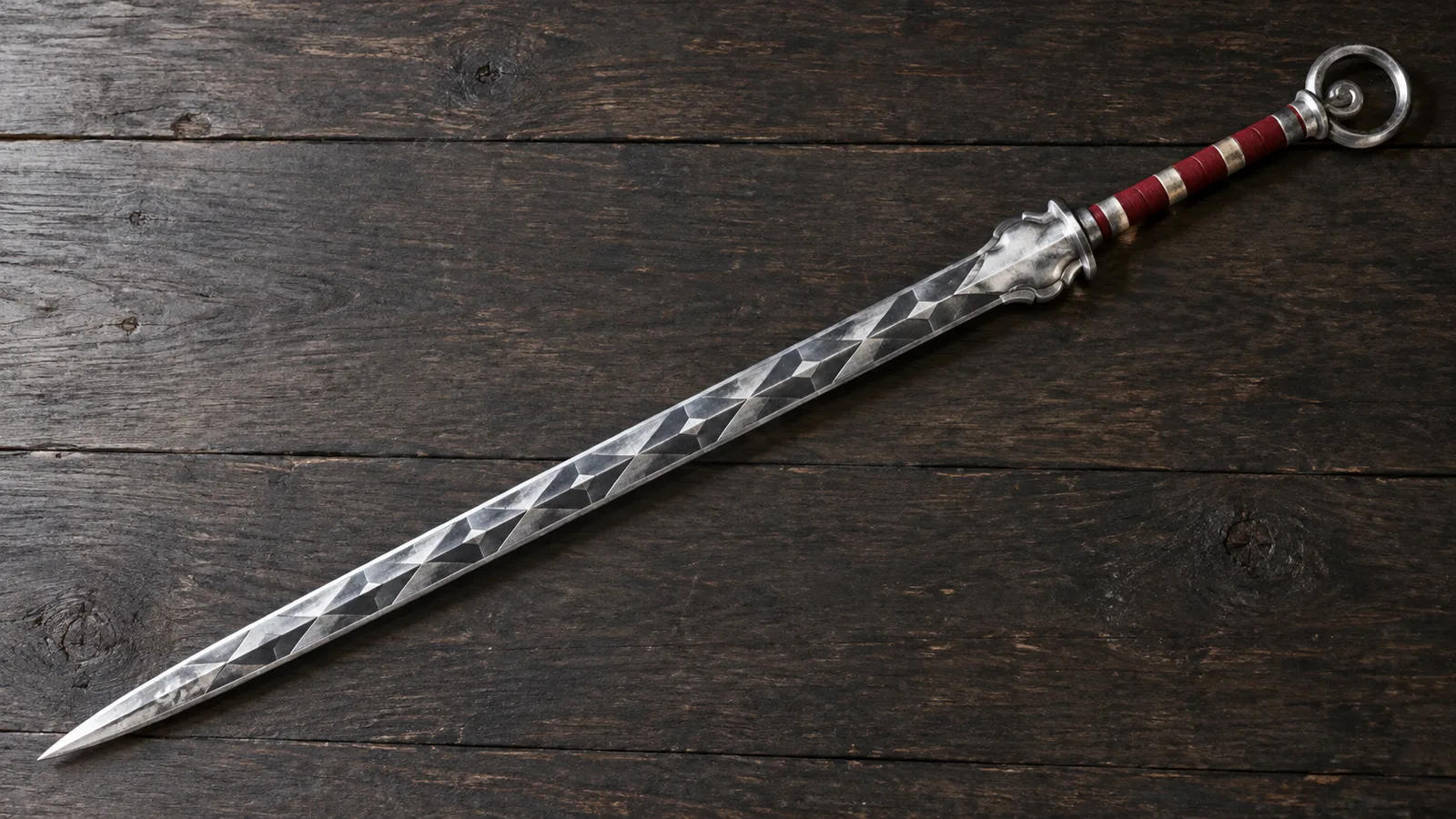
The official Knight weapon guide distinguishes HwanDoo Big Sword, Red HwanDoo Big Sword, White HwanDoo Big Sword and HwanDoo SaeHyung Big Sword. They are separately named items, not interchangeable labels for one illustration. The White item portrait is the design reference for the long patterned blade and ring-ended grip in this article. [1]
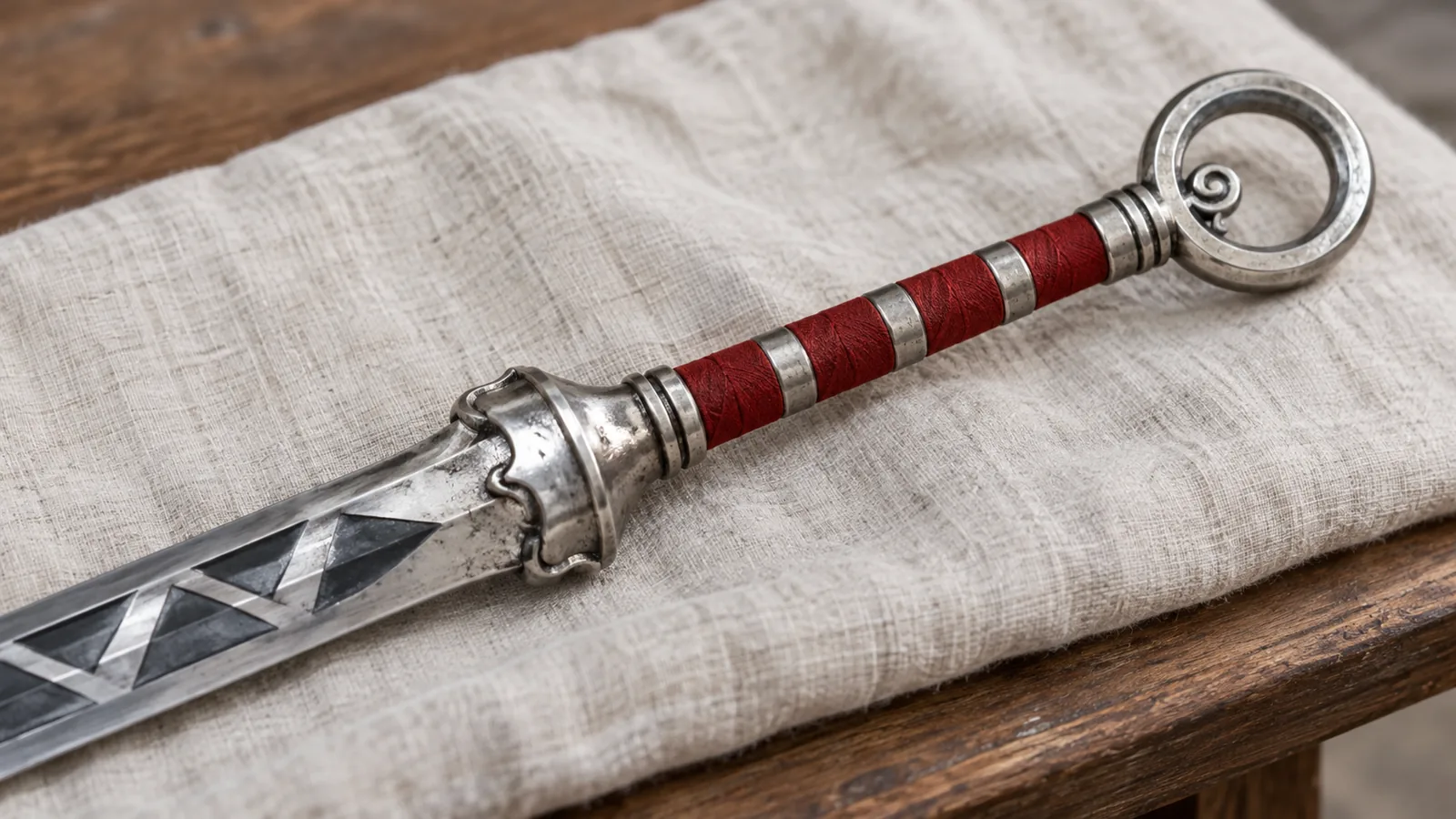
Look at the open circle above the red grip bands. It is easy to overlook beside the blade’s repeating dark geometry. Yet that circle makes the historical comparison much more specific than a general resemblance between fantasy swords and old weapons.
HwanDoo and the ring pommel
The historical Korean term hwandudaedo, 환두대도 / 環頭大刀, identifies a sword with a ring at the end of its hilt. The National Museum of Korea’s Silla example, accession Dongwon1882, is an iron sword recorded as 94 centimetres long. Its ring contains a three-leaf ornament. The museum connects differences in materials and decoration with the standing of the people who carried such weapons. [2]
That is a useful point of comparison, rather than an identification of the game weapon. KalOnline’s White HwanDoo is not the museum’s Dongwon1882, and the generated photograph is not a restoration image of it. The ring-shaped ending supplies a meaningful link; the scale, blade pattern and combat role belong to the game.
A phoenix inside another ring
Gyeongju National Museum preserves a different example from Cheonmachong: a sixth-century Silla sword measuring 97 centimetres. Its ring pommel contains a phoenix. The museum describes the ring and bird as one bronze piece plated with gold, while the wooden handle and sheath were covered with gilt-bronze plates. Its guide distinguishes plain, three-leaf, dragon, phoenix and dragon-head ring designs. [3]
A plain ring and a richly worked phoenix ring are therefore not merely the same prop with different colours. The detail at the end of a hilt could itself become an elaborate object. Following the collection link lets you inspect a real surviving example without asking a new fantasy image to stand in for historical evidence.
We have kept the game-inspired hilt comparatively restrained. Adding a large golden phoenix simply because the museum example has one would produce a new sword. The red bands, pale metal and small inner curl in the official White portrait are the details that belong here.
What survives inside the iron
A materials study by Hyo Ryeong Choi, Wooil Jung and Nam Chul Cho examines three plain ring-pommel swords from the Asan–Cheonan region, dated in the study from the late third to the early fifth century. The researchers used X-rays, microscopy and elemental analysis to investigate their construction. Repeated forging left evidence in the metal’s structure; no particular heat-treatment traces were identified in the studied samples. [4]
Such work asks a different question from an equipment table. It seeks evidence of how an actual object was made. A game statistic describes what designers allow an item to do. Neither kind of information replaces the other, and a photograph of our imagined prop cannot tell us how an excavated sword was forged.
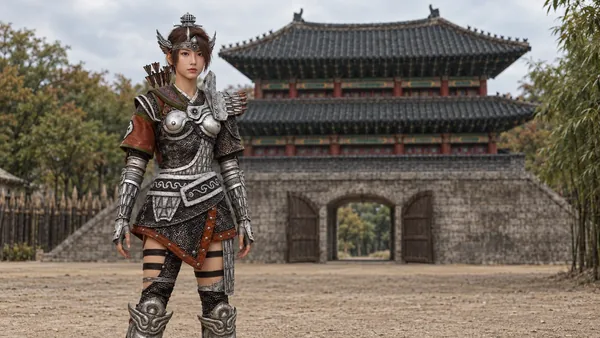
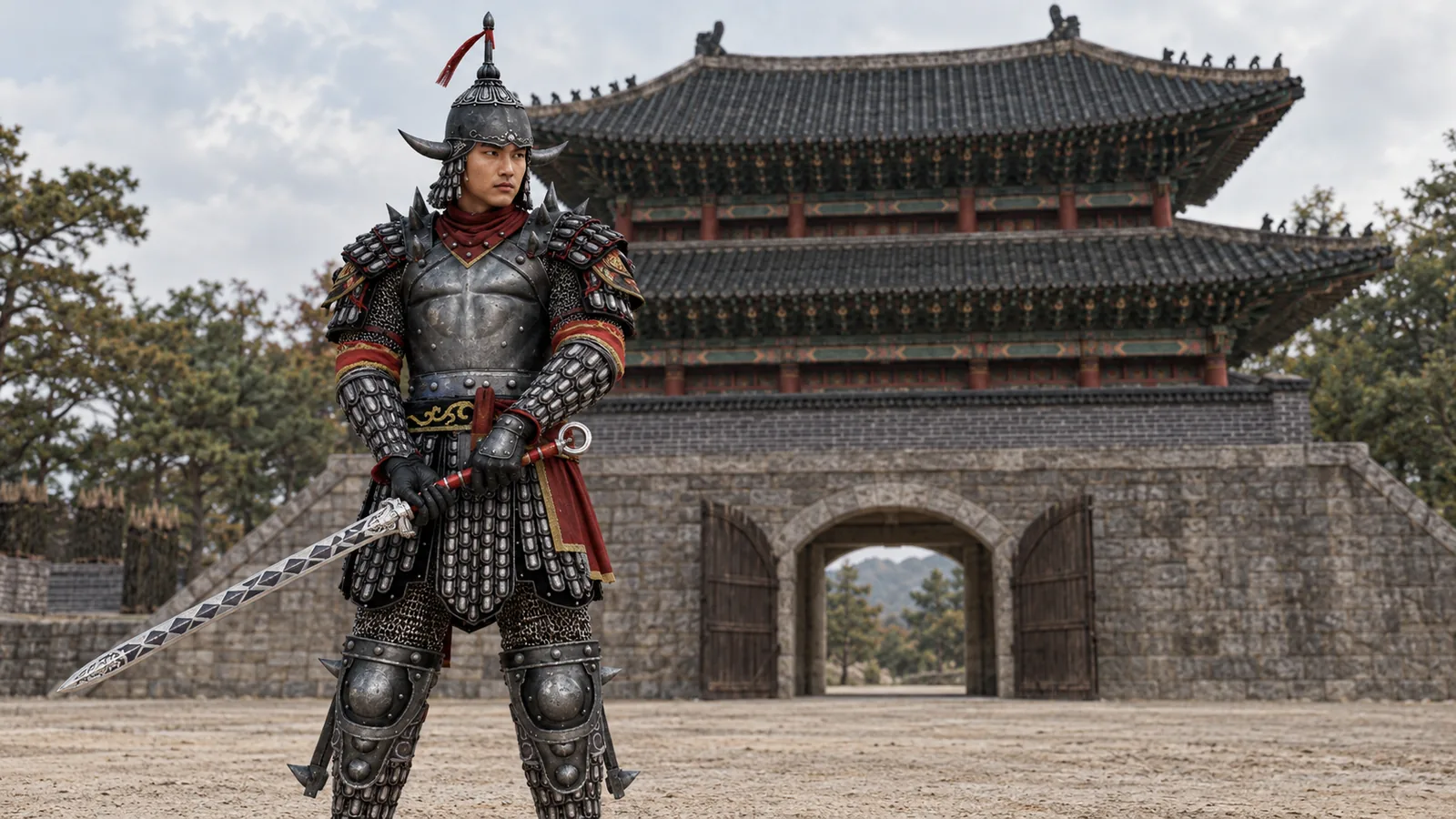
The Knight scene puts the item back into the visual world where many readers first met its name. A man at rest holds the blade low, against a gate adapted from the native Temporary Fort reference. The pose and encounter are invented. They give the weapon a human scale without turning the picture into a claim about a historical soldier.
The neighbouring name is a different sword
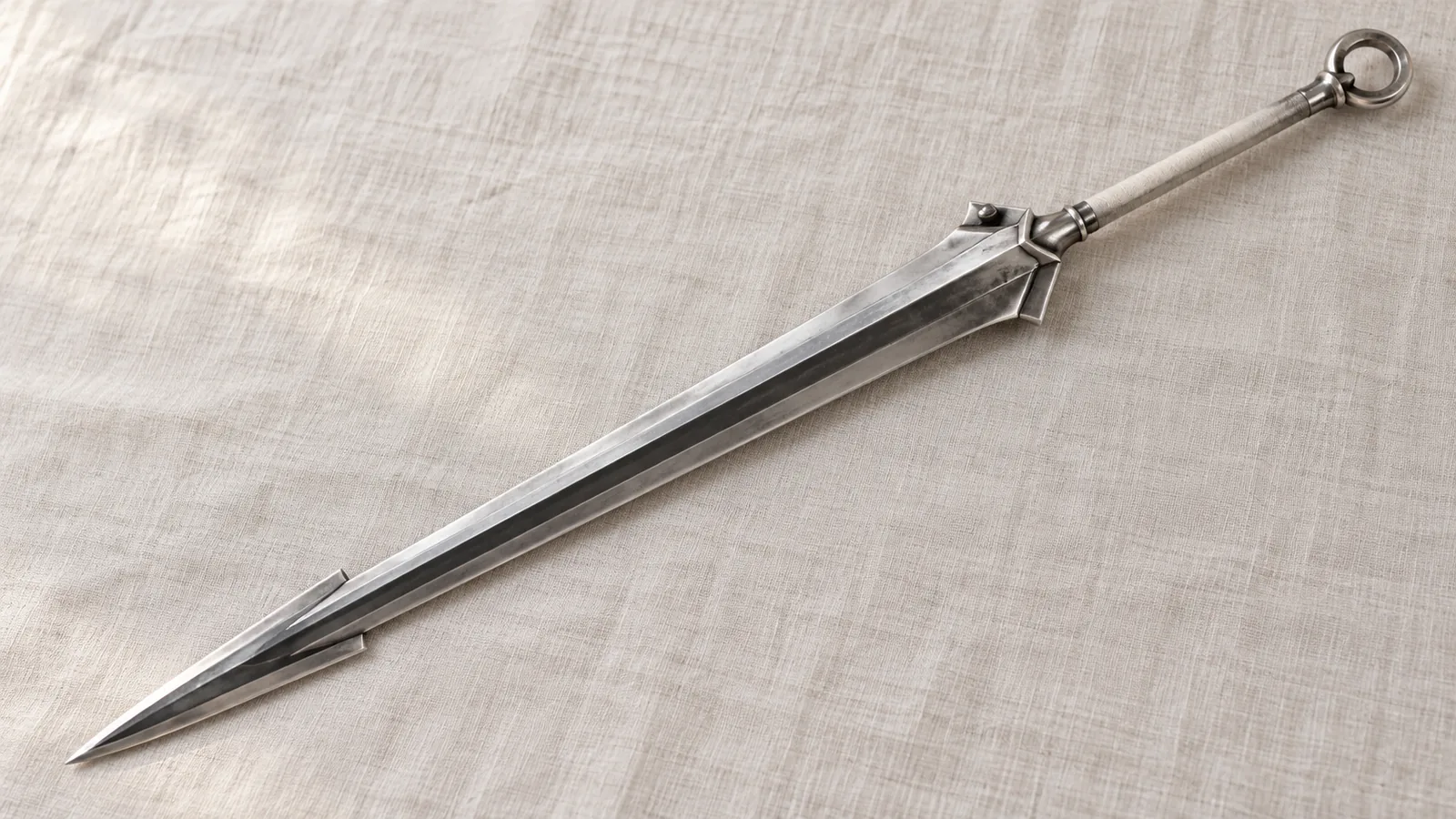
In the surviving game configuration, White HwanDoo is item 101; HwanDoo SaeHyung is item 102. Those are internal identifiers, not character levels or historical dates. Their official portraits also differ. The final photograph follows the plainer SaeHyung portrait separately, instead of borrowing its blade and calling it White HwanDoo.
A 2006 player record helps place the broader family in the remembered game: Tony Chou’s merchant guide lists HwanDoo and HwanDoo SaeHyung under Knight weapon merchant Mak-Sae at Temporary Fort. It does not independently date every White variant. [5]
The SaeHyung spelling invites another possible historical comparison, but an original Korean item name or developer explanation would be needed to establish it securely. We leave that question open. A familiar-looking English localisation should not become a confident archaeological claim merely because it sounds persuasive.
The object and the evening you remember
For a returning player, a weapon may recall a trade, a gift, or the moment a character finally looked complete. The historical ring does not replace those associations. It adds something you can notice the next time the old item appears: the end of a hilt carried a recognisable idea long before it became a few pixels in an inventory.
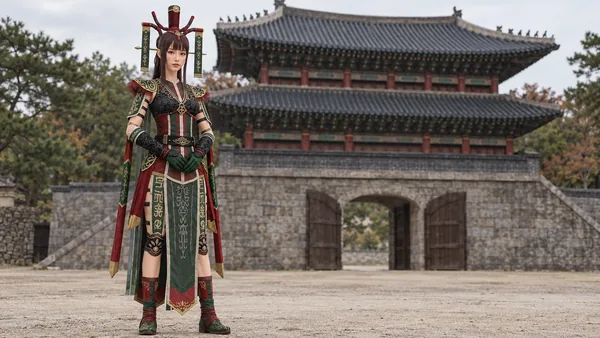
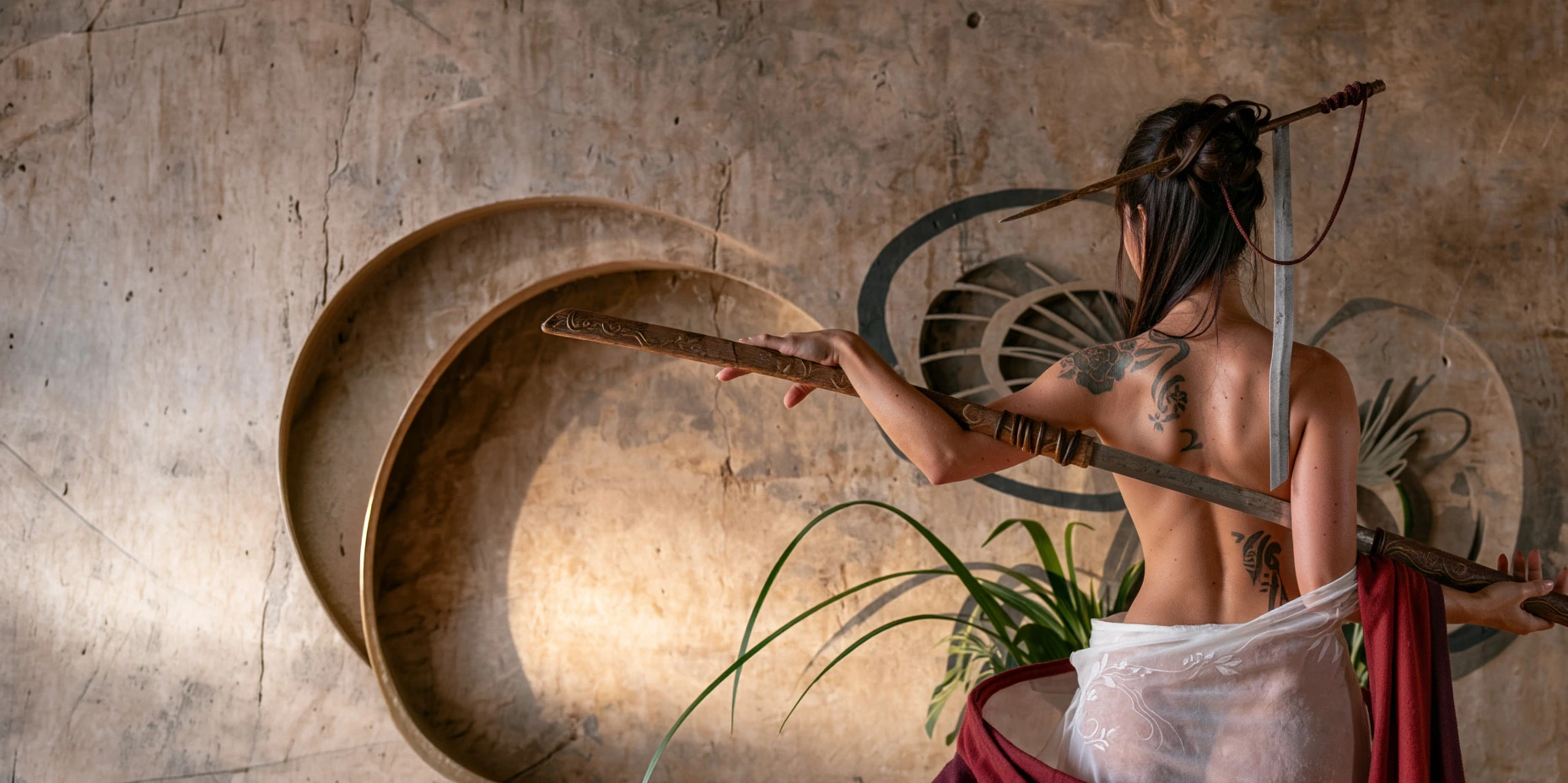
The four images here are new photographic interpretations. They retain visible features from the official inventory portraits and use a native Knight costume where a wearer is shown. The tiny source images do not establish every scratch, seam or tool mark; those surfaces are imagined. Follow the museum links below for the actual archaeological objects.
Tell us which HwanDoo you remember, and include the server or year if you can. An old screenshot is particularly helpful when identifying variants. The name, the blade and the hilt should agree before a memory is attached to a specific item.
Sources & image credits
Research checked on 16 October 2026. Cultural scholarship, a dated player guide and current game records are identified separately. Photographic scenes are new AI interpretations of game references. Museum objects can be viewed through the collection links; their photographs are not reproduced here.
- Knight weapons · official KalOnline guideINIXSOFT / KalOnlineThe official White HwanDoo and HwanDoo SaeHyung inventory portraits were consulted as private visual references. Current guide checked 16 October 2026; it does not date every variant to 2004–2007.
- Swords With Ring Pommel · Dongwon1882National Museum of KoreaCollection record: Silla, iron, length 94.0 cm. Its museum photographs are not the generated prop images in this article.
- Sword with Phoenix-shaped Ring-pommelGyeongju National MuseumCollection record: Cheonmachong, Silla, sixth century, length 97.0 cm.
- Metallurigical Analysis of Third to Fifth Century Swords with Ring Pommels Excavated in the Asan-Cheonan RegionHyo Ryeong Choi, Wooil Jung and Nam Chul Cho · Journal of Conservation Science 39(5), 721–731 · 2023Original archaeological materials study. It examines three excavated swords, not a KalOnline weapon.
- Kal Online Merchant FAQ, version 3.0Tony Chou · GameFAQs, listed under Brave_Song · 2006-05-26Page marked updated 26 May 2006. A contemporary player-authored record, not an official price guarantee. Its historical spelling CaeChangEau is identified where relevant.