


The name you learned before its story
Perhaps you remember the route before you remember its name: leaving town, checking your supplies, reaching the same patch of forest and settling into another evening with your party. Doggebi belongs to that vocabulary of repetition. It was a name to call out, a shape to recognise and, sometimes, a problem standing between you and the next quest. But there is a cultural story behind that familiar word.
The Korean word is dokkaebi, written 도깨비. The National Institute of Korean Language's Korean–English Learners' Dictionary gives both dokkaebi and goblin as English equivalents, with a familiar horned, club-carrying figure in its definition. For a KalOnline player, Korean goblin is a useful first explanation. It is a starting point, rather than a complete description of everything the creature can be. [1]
We read KalOnline's Doggebi spelling in that Korean cultural context. The official English monster guide uses Doggebi but does not explain the localisation choice; we have not found a developer statement establishing its exact spelling history. The connection explored here is a cultural and linguistic reading, not a newly discovered piece of production history. [6]
A spirit in the things people leave behind
In the Academy of Korean Studies' account, dokkaebi can arise from natural things such as wood and stone, or from objects that people have used. Old brooms, pokers and other familiar belongings can turn strange. This differs from the idea of a ghost as the surviving soul of a dead person. The uncanny presence may come from an everyday object, rather than a human death. [2]
That gives the stories an intimate scale. A roadside encounter does not need an infernal kingdom or a distant war to explain it. The old implement in a corner, the abandoned house or the path home can be enough. It is an especially appealing idea for a game whose atmosphere often depends on the small things we walk past.
Strong enough to frighten you, foolish enough to lose
Heo Yongho's entry for the National Folk Museum of Korea describes beings with extraordinary powers who tease people and sometimes help them. Their preferred settings include dark, damp places and nights, but also foggy or rainy days. They can challenge a passer-by to wrestle through the night, and they enjoy singing and dancing. One story even has a borrower repeatedly returning money that has already been repaid. [3]
Their power is not limited to mischief. The same account connects them with abundant food, good harvests, successful fishing and fortune. Fear and usefulness exist together: these are formidable beings whose powers people may hope to turn towards a better life. Treating every dokkaebi as a purely evil monster misses that contradiction. [3]
For players, the interesting parallel is temperament. A creature can be intimidating and still have a ridiculous side. The joke does not need to erase its strength; sometimes the strength is exactly what makes its foolishness funny.
The magic club promises more than damage
KBS WORLD's 2021 retelling of The Goblin's Magic Club follows a kind younger brother and a greedy older one. Sheltering from rain, the younger brother encounters dokkaebi who use their clubs to produce a feast. He escapes with a club they leave behind. His older brother tries to repeat the success, but the creatures recognise the apparent thief and punish him. This is one published retelling, not the only version of the tale. [4]
Read beside a game inventory, the club suggests a different kind of power: the ability to make plenty appear when ordinary life offers too little. A weapon icon tells us what an item does in combat. A folktale asks what someone might wish for if that item could change their life.
The Academy's entry on dokkaebi tales also describes a magical hat story in which a man uses the object to steal, only to be found out. The entry identifies a warning against greed. Club and hat stories are therefore more than a catalogue of supernatural equipment: what a person does with the opportunity matters. [5]
There is no single face for every dokkaebi
A horn and a club make an immediately recognisable shorthand, but the folklore is less fixed. The Academy of Korean Studies describes changing appearances, including giants and beings that are heard rather than seen. It also records stories in which a dokkaebi can be outwitted by an ordinary person. One standard monster silhouette cannot contain all those possibilities. [2]
That is why this article keeps two questions separate: what dokkaebi mean in Korean tradition, and what a particular Doggebi looks like in KalOnline. The first has many answers across stories. The second deserves close attention to the game's actual artwork. A vaguely Asian fantasy creature would not be a faithful substitute for a face players already know.
How KalOnline made the idea its own
The official English guide divides the family into named creatures, including Doggebi of Monster Face, Doggebi with a Gong, Drunken Doggebi and masked variants. It also emphasises their tremendous physical strength. Those are details of KalOnline's design, rather than a list of fixed categories from Korean folklore. We use the current guide to identify designs and names, not to date every variant's introduction to 2004–2007. [6]
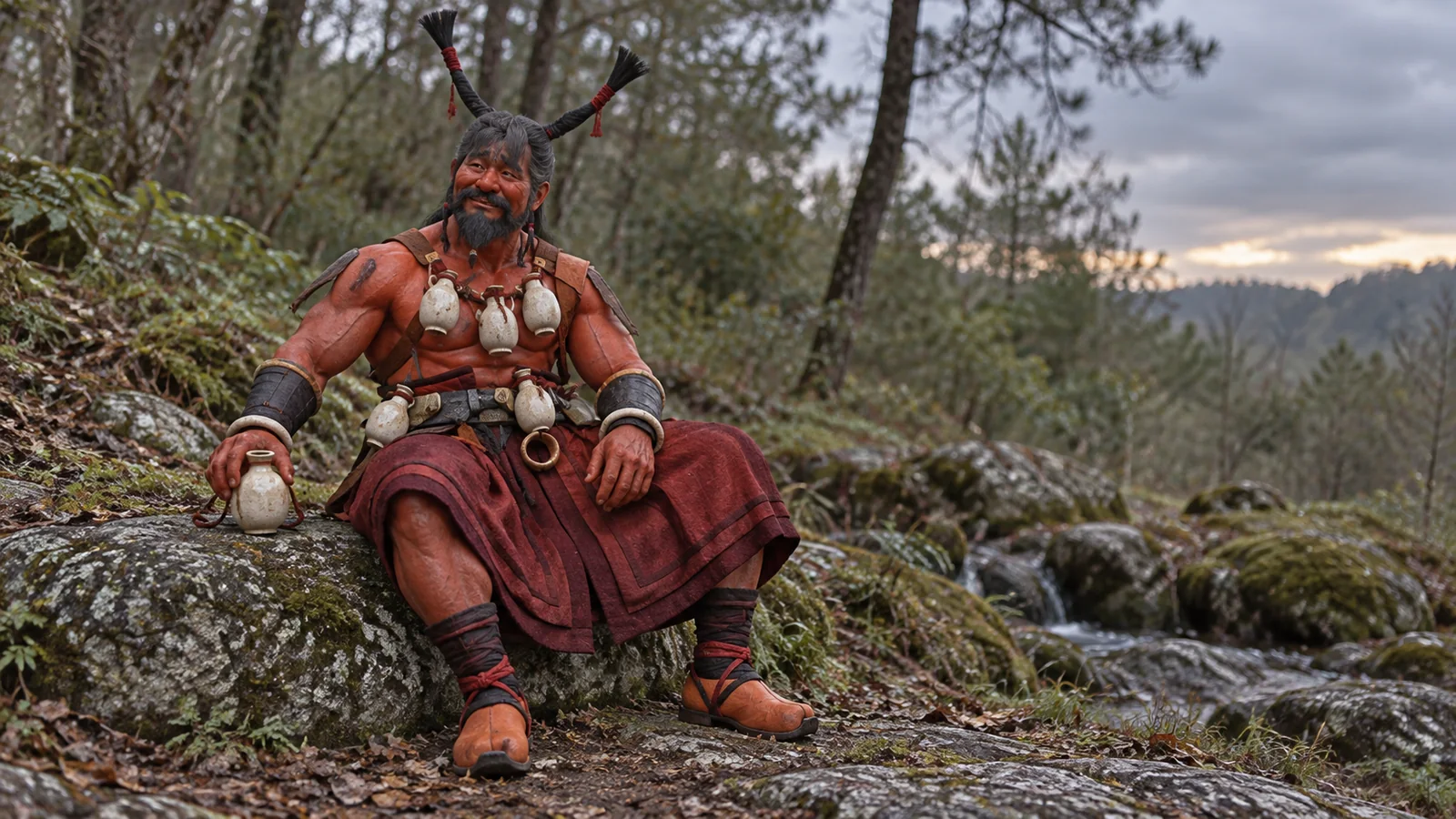
The distinction makes the connection more interesting. The game gives us recognisable opponents and roles; the stories give us a way to think beyond the health bar. The mischievous drinker in our second image is an imagined moment of rest, not a claim about a hidden animation, a particular quest scene or a real player encounter.
The Doggebi who wants to be a friend
Our quest guide contains an especially suggestive name: Doggebi Who Wants To Be a Friend with Humans. In the level-45 doll assignment, the recorded conversation involves a defective doll, Doll Craftsman Gill-Jun and the repaired Doggebi's Doll. These details come from the legacy quest data used by Kal2006. They are game evidence, not proof that this quest adapts a particular traditional tale. [7]
Still, a creature whose name announces a wish for friendship is a useful reminder to look again. The same world can contain hostile Doggebi and a Doggebi who asks for something more ordinary. That small change of perspective is where a monster begins to feel like part of a place.
What stays with us after the levels are forgotten
For someone returning to the 2004–2007 era, the appeal may be less about learning a new fact than finding a new layer in an old memory. You might have spent hundreds of encounters reading the word Doggebi without once asking what it meant. Knowing the folklore does not replace those evenings. It gives the familiar name another life.
Which Doggebi do you remember first: the one on a hunting route, the one needed for a quest, or the one whose appearance always made you smile? Leave your own memory or a correction in the article comments. Personal recollections help us preserve the experience; dated sources help us distinguish memory from the historical record.
About the photographs in this article
Both images are new AI-generated photographic interpretations made for this article, using the official monster portraits as design references. The forest settings and the resting pose are imagined. They are not original screenshots, photographs of a real creature, historical records or verified reconstructions of a named game map. Their restrained colour and soft daylight follow Kal2006's visual tone while keeping the referenced costumes recognisable.
Sources & image credits
Research checked on 16 October 2026. Cultural accounts, modern retellings and game records are identified separately. New photographs are AI-generated interpretations; the official portraits used as design references are not reproduced on this page.
- Dokkaebi (도깨비): Korean–English Learners’ DictionaryNational Institute of Korean Language
- Dokkaebi (도깨비)Im Dong-gwon · Encyclopedia of Korean Culture, Academy of Korean Studies · 2023-02-07Entry revised in 2023; this is not a proposed origin date for the tradition.
- Goblin (도깨비)Heo Yongho · Encyclopedia of Korean Folk Culture, National Folk Museum of Korea
- The Goblin’s Magic ClubKBS WORLD · 2021-07-27A modern English retelling; not a claim that all versions have the same plot.
- Dokkaebi tales (도깨비 설화)Encyclopedia of Korean Culture, Academy of Korean Studies
- Doggebi: official KalOnline monster guideINIXSOFT / KalOnlineCurrent guide consulted on 16 October 2026 for names and design references. It does not establish the 2004–2007 release date or level of each variant. Official portrait artwork remains © INIXSOFT; it was used as a private visual reference and is not republished here.
- Defective Doggebi’s Doll: legacy quest guideKal2006 Knowledge Base · extracted legacy quest dataA record of this server’s legacy quest data, not a museum source or proof of a specific traditional tale adaptation.
Share your Doggebi memory or a correction →
How KalOnline began · The Doggebi's Doll quest · All stories