The upgrade you could recognise across town
An armour set can hold the memory of an entire stage of a game. Perhaps yours is the first time a familiar Archer passed you in town wearing something you were still saving for. You checked the silhouette, opened your inventory and counted again. The name on the item became part of that small private ambition. DooSukLinGap is a good place to return to that feeling, because its unfamiliar syllables lead somewhere quite concrete.
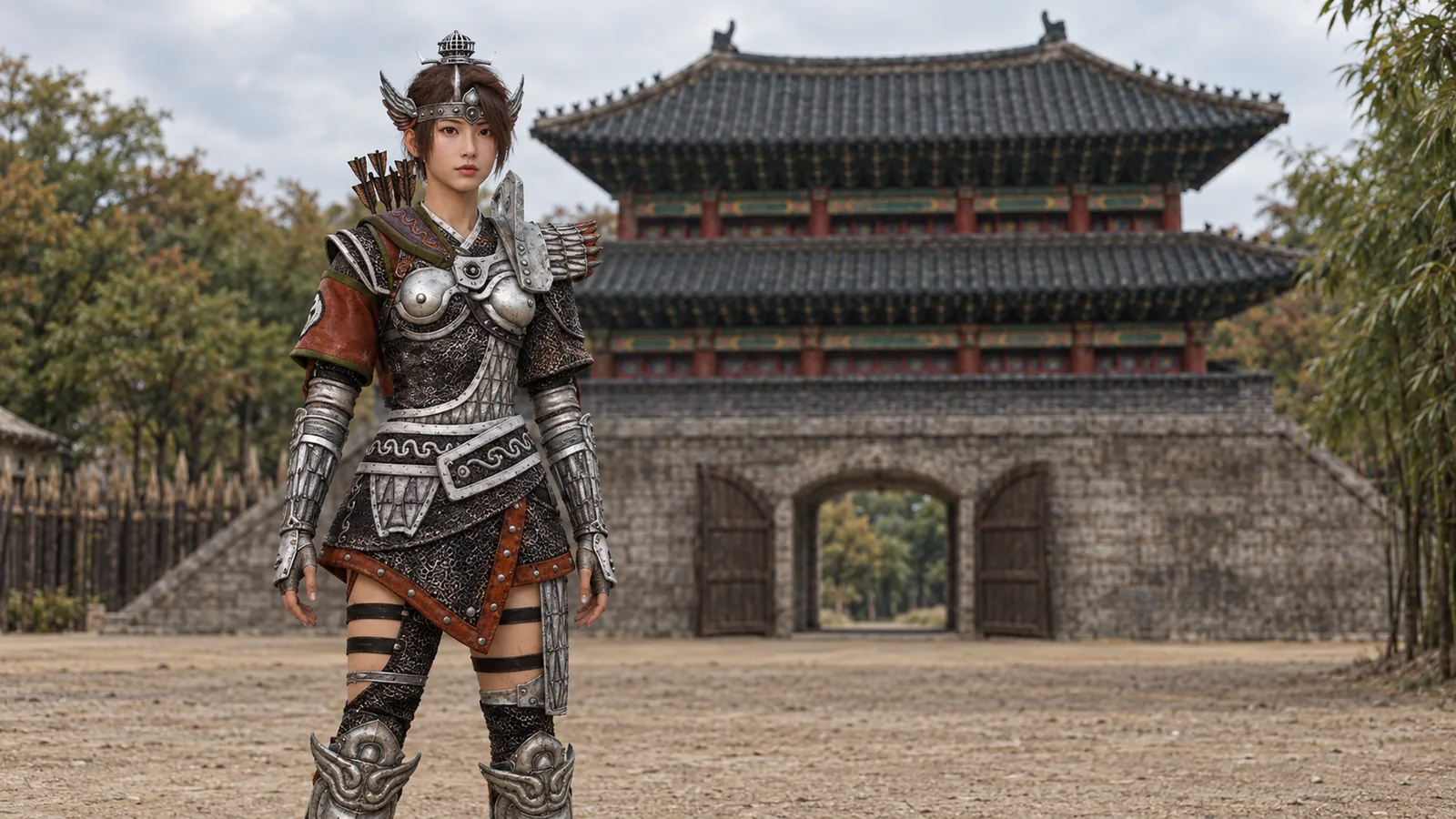
The official Archer guide lists DooSukLinGap at grade 42 and SinGak DooSukLin at grade 46. They belong to the Archer wardrobe. The silver G42 set and the bronze-toned G46 variation shown here follow different native costume references; the Knight’s similarly graded GangChulGap is another set entirely. [1]
That distinction matters when bringing an old game into photographs. A polished suit of unrelated fantasy armour might look impressive, but it would miss the recognition that makes this particular outfit worth remembering.
What the Korean name describes
The close historical match is duseoklingap, 두석린갑, written 豆錫鱗甲. Park Jae-gwang’s entry for the Academy of Korean Studies describes Joseon armour with brass scales attached to a garment. The small overlapping pieces suggest fish or dragon scales. Here duseok refers to brass, an alloy based on copper and zinc; translating the name as tin armour would misidentify the material. [2]
The same account distinguishes its construction from earlier lamellar armour. Plates in the earlier form were laced directly to one another; in this Joseon form the scales were fixed to a coat-like foundation. Two surfaces can look similarly segmented while being assembled in different ways. The material and the method tell a more precise story than a broad label such as ancient Asian armour. [2]
Brass, colour and the appearance of authority
The National Palace Museum’s illustrated royal-culture catalogue describes black, red and yellow scales arranged over a red woollen foundation. It discusses matching armour and head protection, and compares an 1891 illustration with photographs from the early twentieth century. Those are records of historical objects and their display, rather than a ready-made explanation of KalOnline’s costume. [3]
Park also notes that brass is less hard than iron and gives an attractive golden colour. He therefore suggests that decorative effect received relatively greater emphasis in this armour. That is the author’s interpretation of the historical material choice, not proof that every example was purely ceremonial or that brass offered no protection. [2]
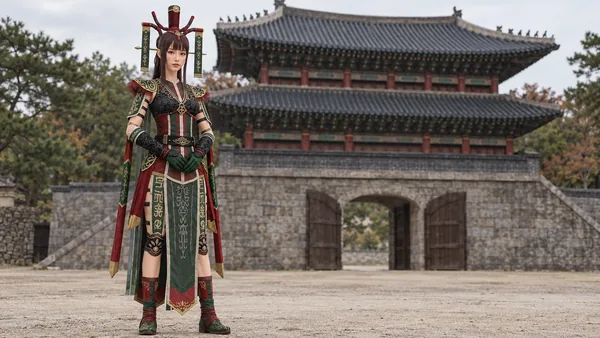
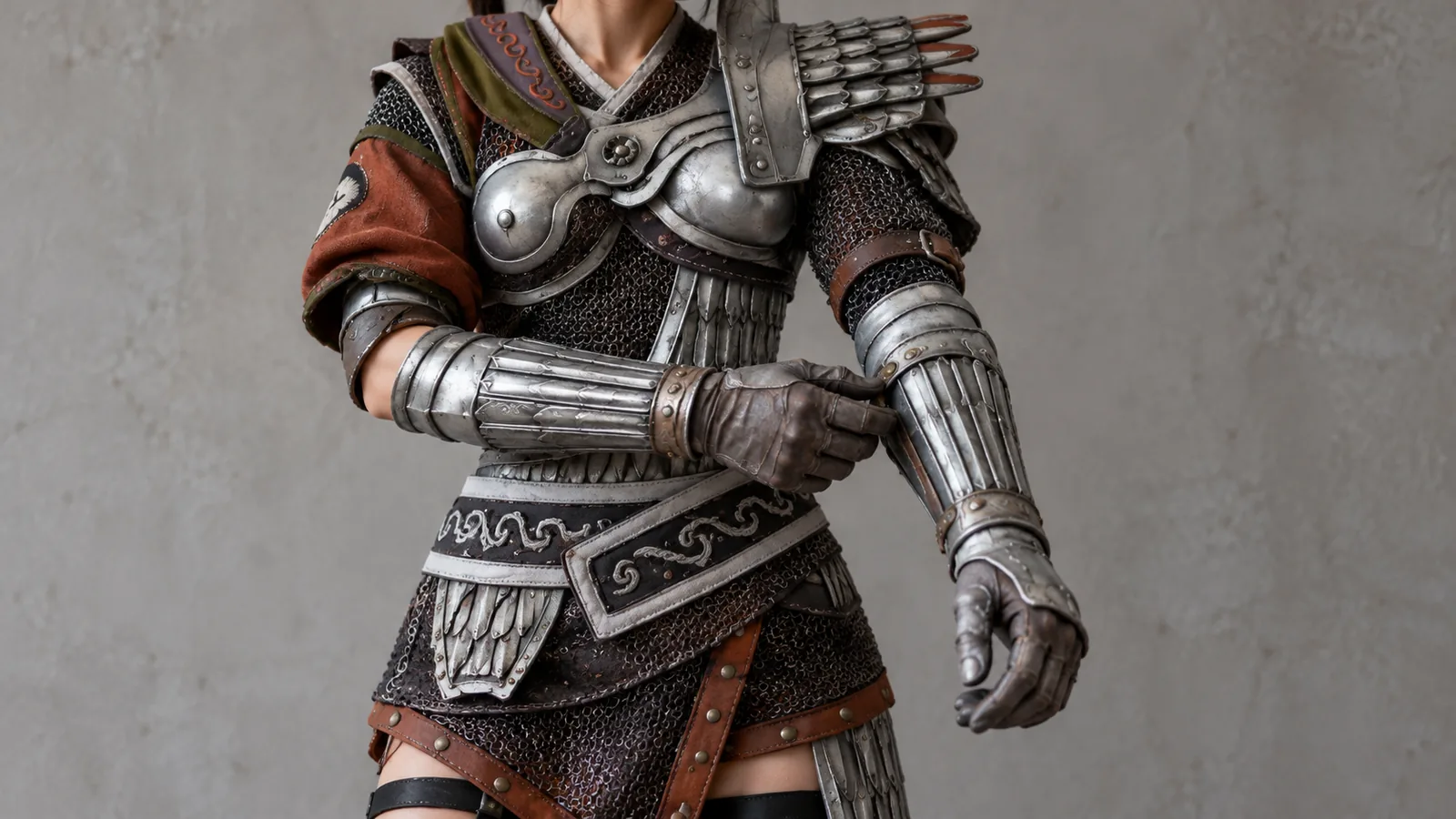
The palette in our Archer photographs stays with the game reference: silver plates, dark chainmail and rust-coloured cloth. Changing it all to gold to fit the historical name would erase exactly the outfit we came to examine. The historical connection is strongest in the vocabulary; the costume remains KalOnline’s own visual invention.
A name already on the shopping list in 2006
There is a useful contemporary trace. Tony Chou’s Merchant FAQ, listed by GameFAQs under Brave_Song and marked updated 26 May 2006, records DooSukLinGap G42 under Archer armour merchant Chung-Wal at Temporary Fort of Geum-Ohee Castle. It also lists separate pieces of the set. This dates the name to a player’s 2006 guide; its listed prices are not presented as today’s server prices. [4]
A merchant list is a modest kind of history. It preserves what someone thought another player would need to find. Beside the grand stories of castles and guilds, there is also the ordinary business of travelling to the right shop, comparing pieces and deciding what the next evening’s hunting should pay for.
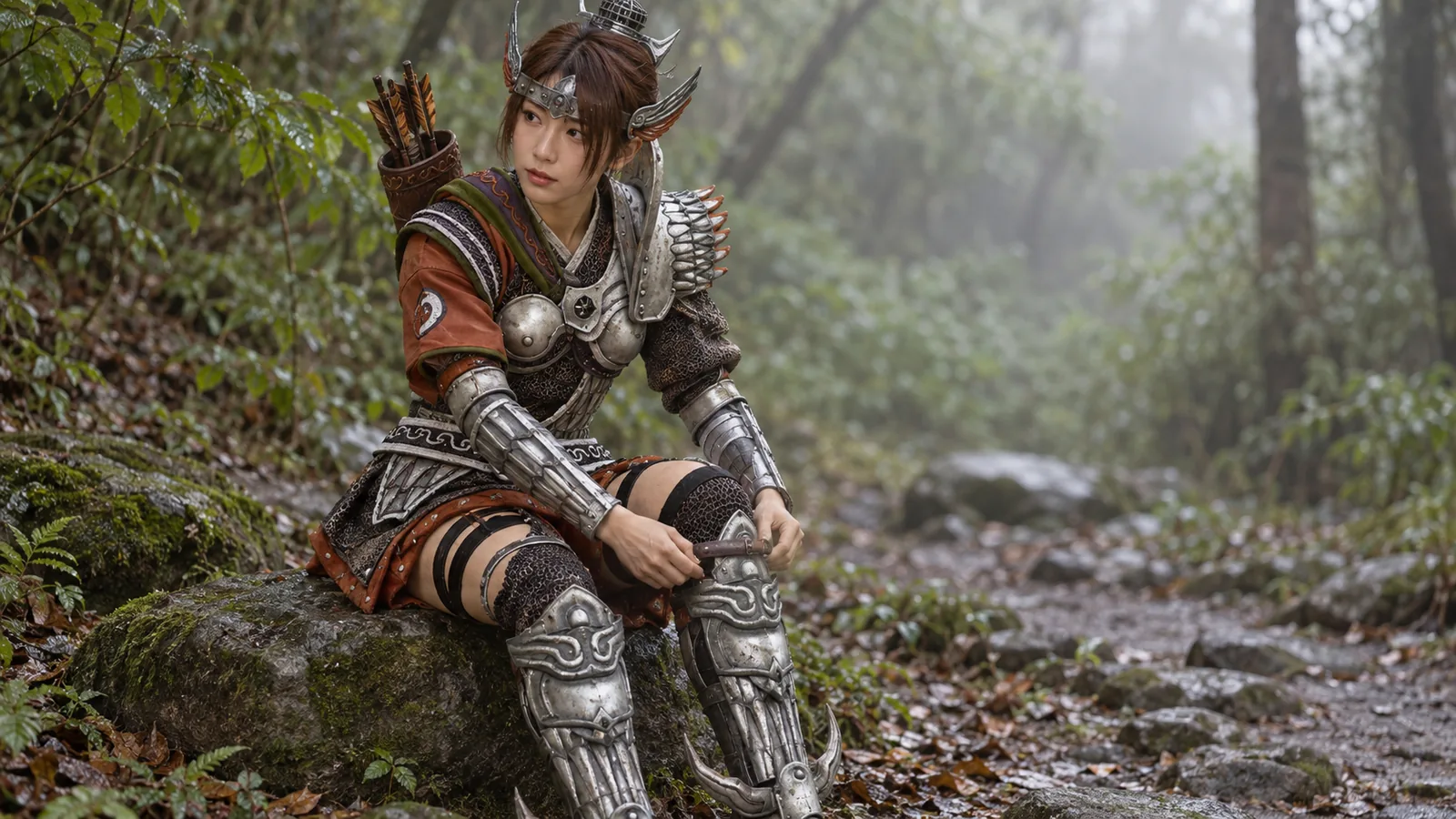
The figure resting on the woodland path is an imagined pause between those errands. The setting has no claimed map name. Its purpose is to make the familiar costume feel worn by someone who has walked in it, rather than to invent a new landmark in a place players know by heart.
Scales are only one part of a larger wardrobe
Choi Eun-su’s Academy-hosted entry on military clothing places duseoklingap alongside other armour forms, including studded, leather, mail and padded protection. It also discusses military robes. Historical Korean military dress therefore cannot be reduced to one shiny surface or one standard suit. Different names identify different constructions and uses. [5]
Look closely at the G42 game-inspired photographs and the mixture is part of their character: raised plates beside flexible mail, a hard wrist guard meeting cloth, the abrupt change from metal to a leather fastening. The detail view makes those boundaries visible. It is a way to look at the game design, not a demonstration that a museum object had precisely the same joins.
The next variation, and the memories between sets
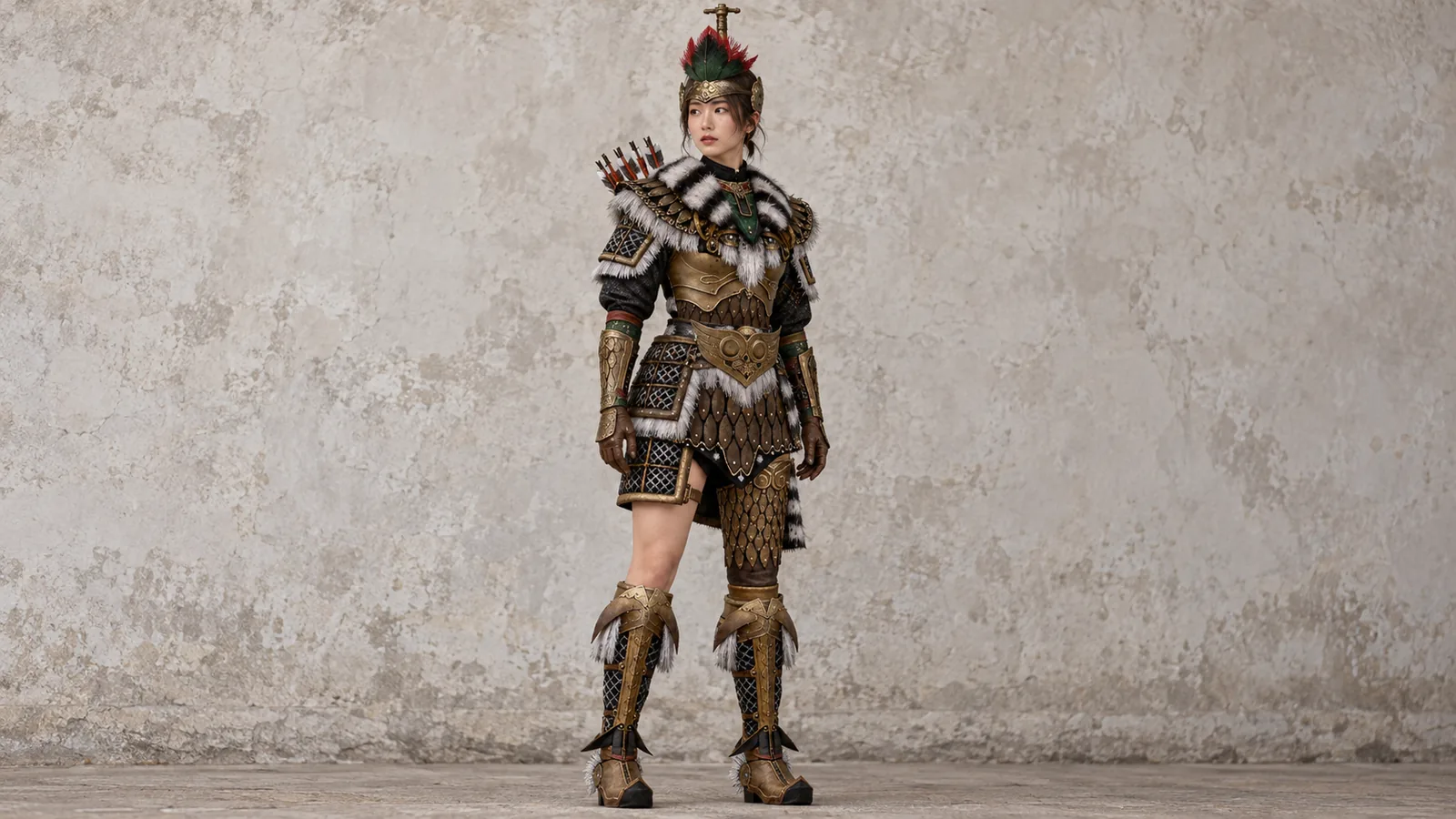
The final image moves to the separately referenced SinGak variation: bronze tones, striped fur and a green accent replace the colder silver impression. Keeping that difference legible is more useful than making every grade look like the same expensive modern costume. A returning player should be able to recognise a change of equipment, not just a change of lighting.
All four photographs are new AI-generated interpretations based on game references. Poses, surfaces too small to resolve in the original textures, and the quiet human moments are imagined. The cultural sources linked below let you compare the real armour tradition on its own terms.
If this was one of your sets, the interesting detail may be who helped you find it, which piece arrived last, or what you wore until you could complete it. Share that memory with the server and approximate year. A remembered detail becomes more valuable when another player can place it.
Sources & image credits
Research checked on 16 October 2026. Cultural scholarship, a dated player guide and current game records are identified separately. Photographic scenes are new AI interpretations of game references. Museum objects can be viewed through the collection links; their photographs are not reproduced here.
- Archer armour · official KalOnline guideINIXSOFT / KalOnlineCurrent guide checked on 16 October 2026 for item names and grades; current combat statistics do not establish the 2006 balance. Native game renders were private design references for new artwork.
- Duseoklingap (두석린갑 / 豆錫鱗甲)Park Jae-gwang · Encyclopedia of Korean Culture, Academy of Korean Studies · 2024-08-20Authored in 2011; revised 20 August 2024. Historical armour terminology, not a statement of KalOnline design intent.
- Royal Culture Illustrated · Duseoklingap, printed page 254National Palace Museum of KoreaThe viewer shows printed page 254 on its page 255. Museum photographs and illustrations are linked for comparison, not reproduced as new artwork.
- Kal Online Merchant FAQ, version 3.0Tony Chou · GameFAQs, listed under Brave_Song · 2006-05-26Page marked updated 26 May 2006. A contemporary player-authored record, not an official price guarantee. Its historical spelling CaeChangEau is identified where relevant.
- Military clothing (무복 / 武服)Choi Eun-su · Sillok Dictionary, Academy of Korean Studies