A wardrobe learned one unfamiliar word at a time
A Magician’s equipment names could become familiar long before their syllables made sense. You learned which name came next, recognised a different headpiece in town and began to associate a colour with a stage of the journey. Returning to those names now reveals a second wardrobe behind the first: Korean clothing vocabulary carried into a fantasy game.
The official Magician guide includes MyungJoo and BeeDan HakChangEau, SoChangEau and DaeChangEau sets. It lists MyungJoo DaeChangEau at grade 42 and BeeDan DaeChangEau at grade 46. The two costumes illustrated here follow those separate native game references, rather than treating every robe name as the same outfit. [1]
Our historical reading compares DaeChangEau with daechangui, HakChangEau with hakchangui, and SoChangEau with sochangui. These are persuasive vocabulary correspondences. We have not found a developer statement establishing the exact history of the English spellings or a particular museum garment used by the designers.
Daechangui was a coat with a particular cut
The Academy-hosted Dictionary of Korean Historical Costumes describes daechangui, 대창의, as an adult man’s coat of the late Joseon period. It has a straight collar, broad sleeves, substantial triangular side gores and an opening down the back. The general side construction is closed, though the dictionary notes surviving examples with small side openings. Such construction details are more informative than simply calling it a robe. [2]
The entry records its use as outerwear for scholar-officials and also beneath other formal garments. A clothing name could identify a shape and a place within layered dress, rather than a single universal costume. Historical usage therefore depends on the wearer and occasion. It does not make a female Magician’s fantasy outfit a documentary portrait of a Joseon scholar. [2]
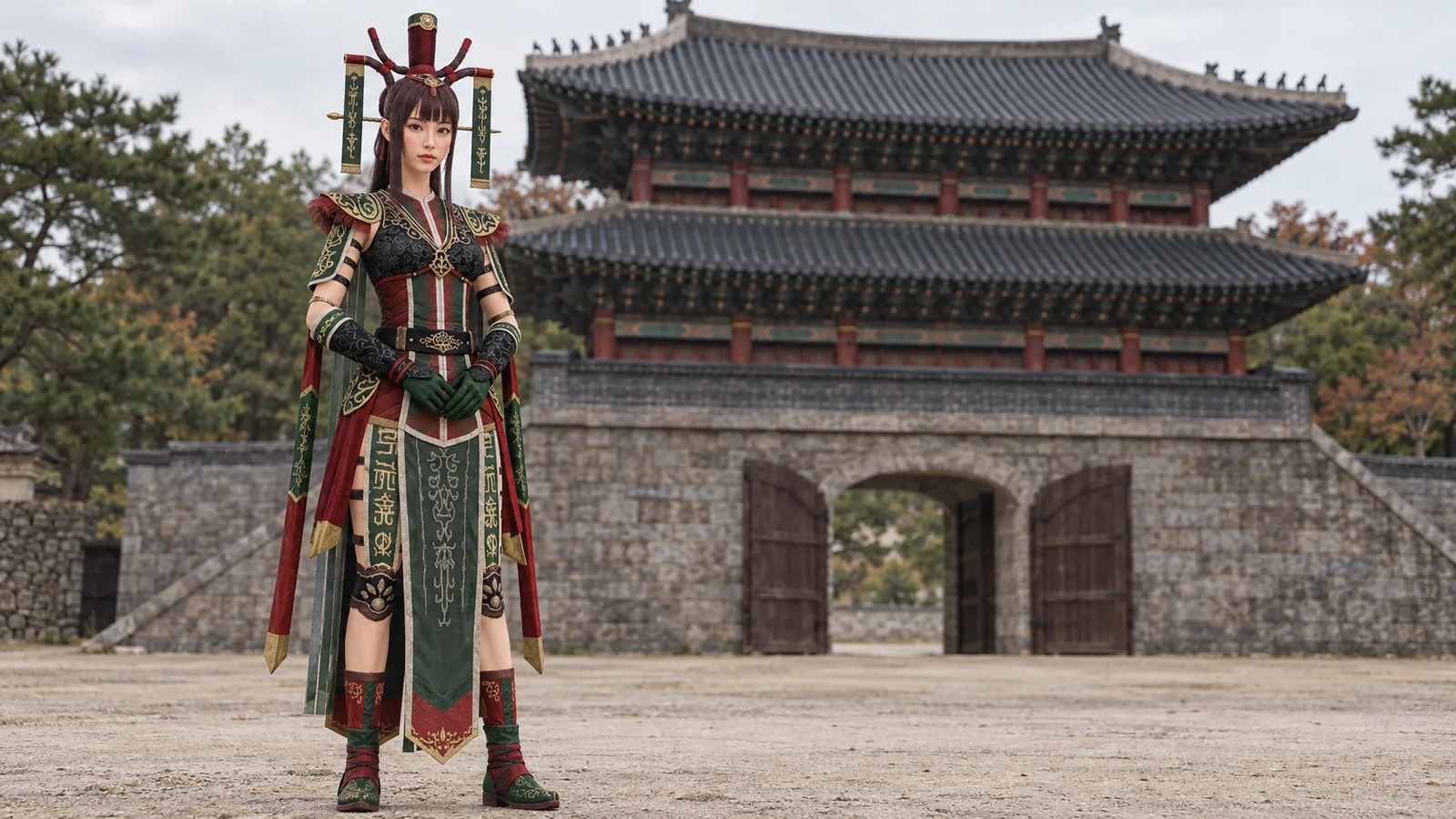
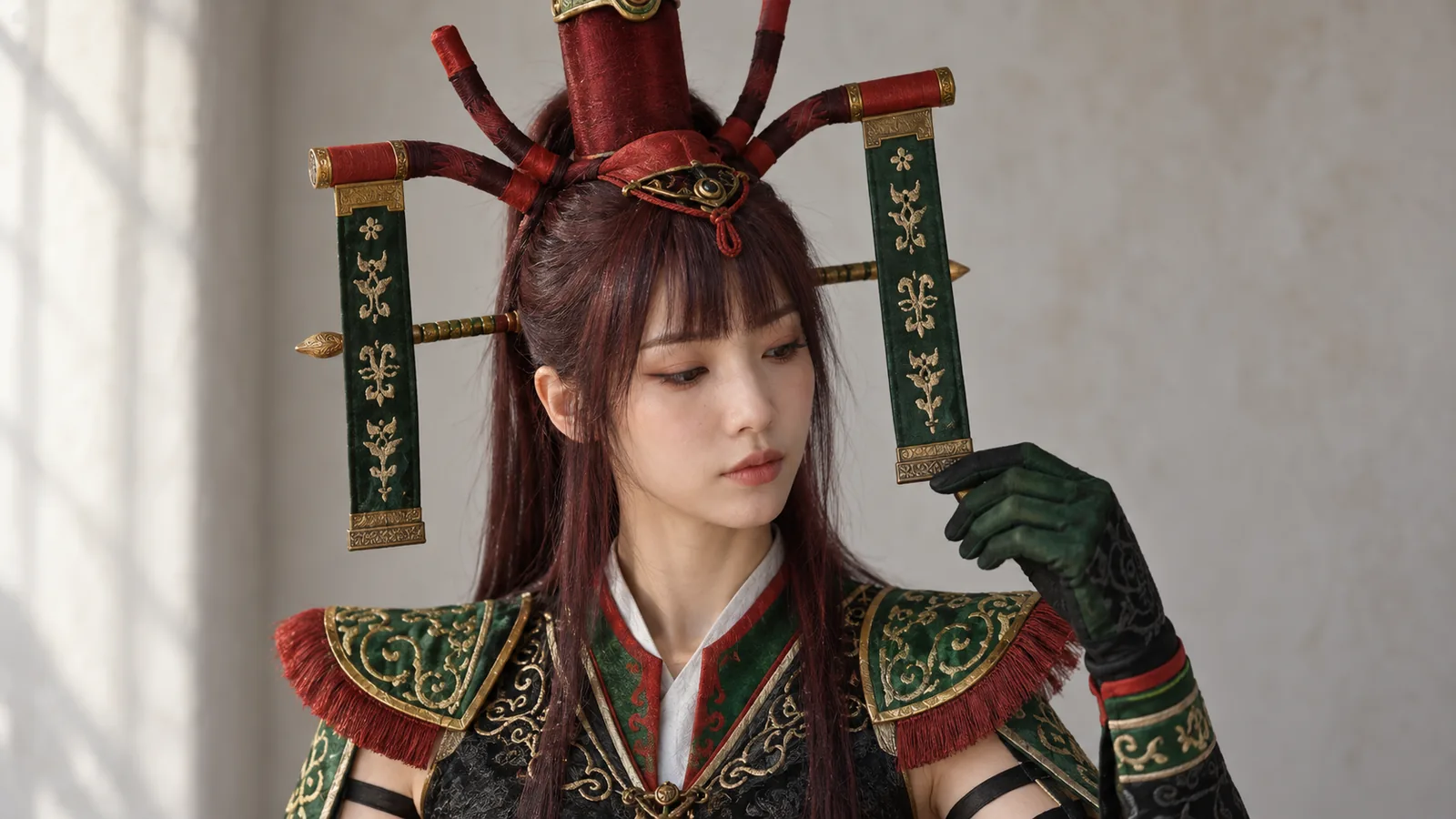
The close portrait shows that distance clearly. Tall headgear, hanging decorated panels and compact shoulder pieces give the game costume its own silhouette. We preserve them in the photograph. Replacing them with a generic period coat would make the picture less faithful to the character the article is about.
HakChangEau and the scholar’s crane
Hakchangui, 학창의 / 鶴氅衣, offers another concrete comparison. The Academy of Korean Studies’ crane entry describes scholars’ clothing with a white ground and black edging at the collar, cuffs and hem, recalling the bird’s appearance. The crane carried associations of dignified scholarly character and longevity. Those are cultural meanings, not claims that wearing the garment prolonged anyone’s life. [3]
That association gives HakChangEau a different resonance when encountered in an equipment list. It opens a discussion of ideals and appearance beyond the next defence value. It does not establish that every game texture contains a crane, that a game headpiece copies historical scholar headwear, or that Magician identifies a particular religious office.
A player can recognise a costume and still be new to the vocabulary behind it. There is no need to choose between affection for the game and curiosity about its sources. An unfamiliar word can be the part of an old item that is genuinely new to us.
SoChangEau brings the story closer to everyday dress
Hong Na-young’s Academy entry describes sochangui, 소창의 / 小氅衣, as a straight-collared coat with narrow sleeves, side openings and no side gores. Scholar-gentry wore it at home or beneath outer robes, while commoners also wore it as outerwear. The account includes silk fabrics, cotton and several colours, with differences in wearer and period. Myungju and bidan appear in its discussion of silk clothing. [4]
The MyungJoo and BeeDan spellings in the game can be read beside that textile vocabulary. The comparison does not establish the exact weave of a low-resolution texture. A name is a useful clue, while fabric construction requires its own evidence. We have kept the photographic textiles tactile without inventing a historical weaving recipe for them.
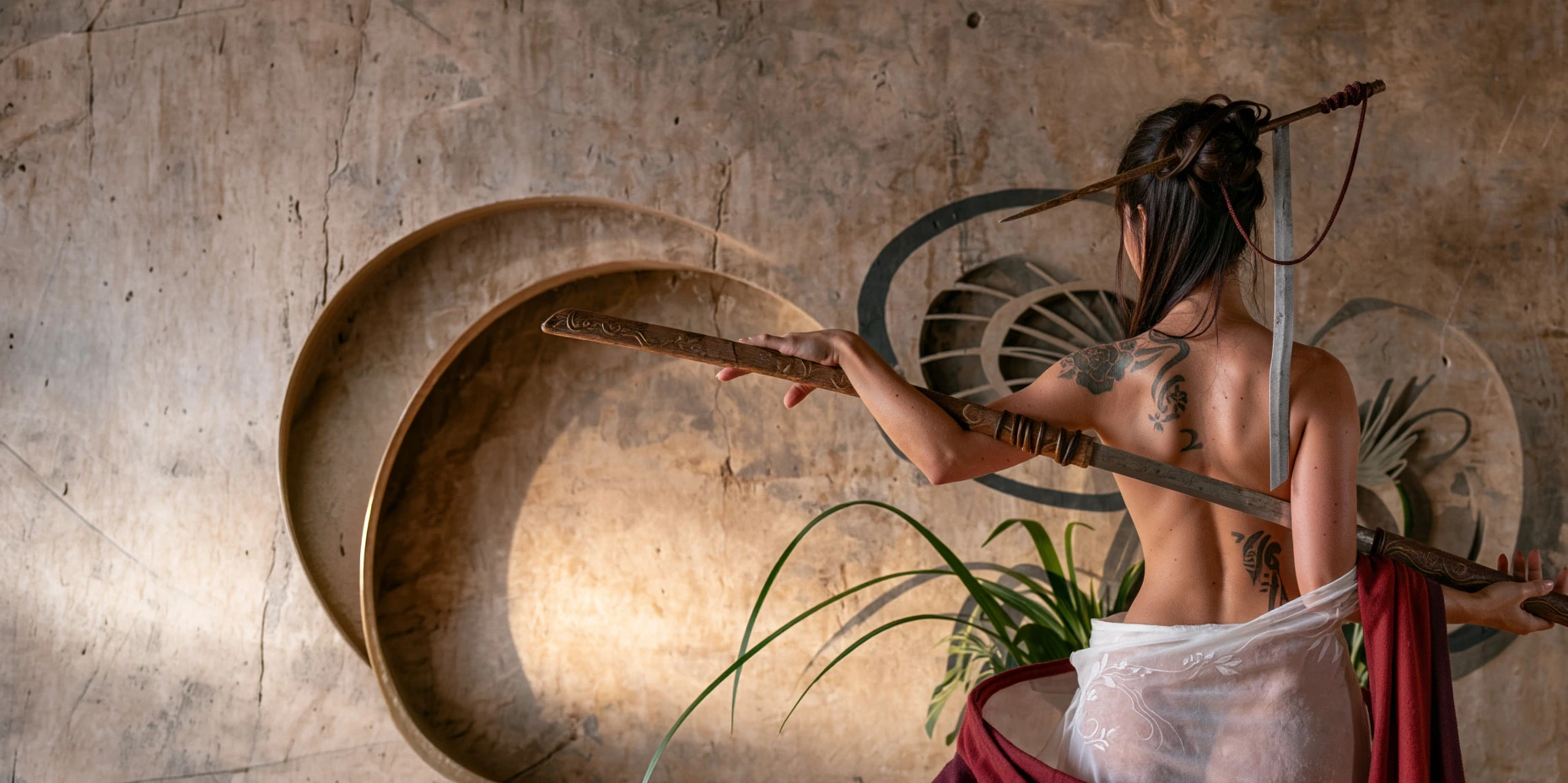
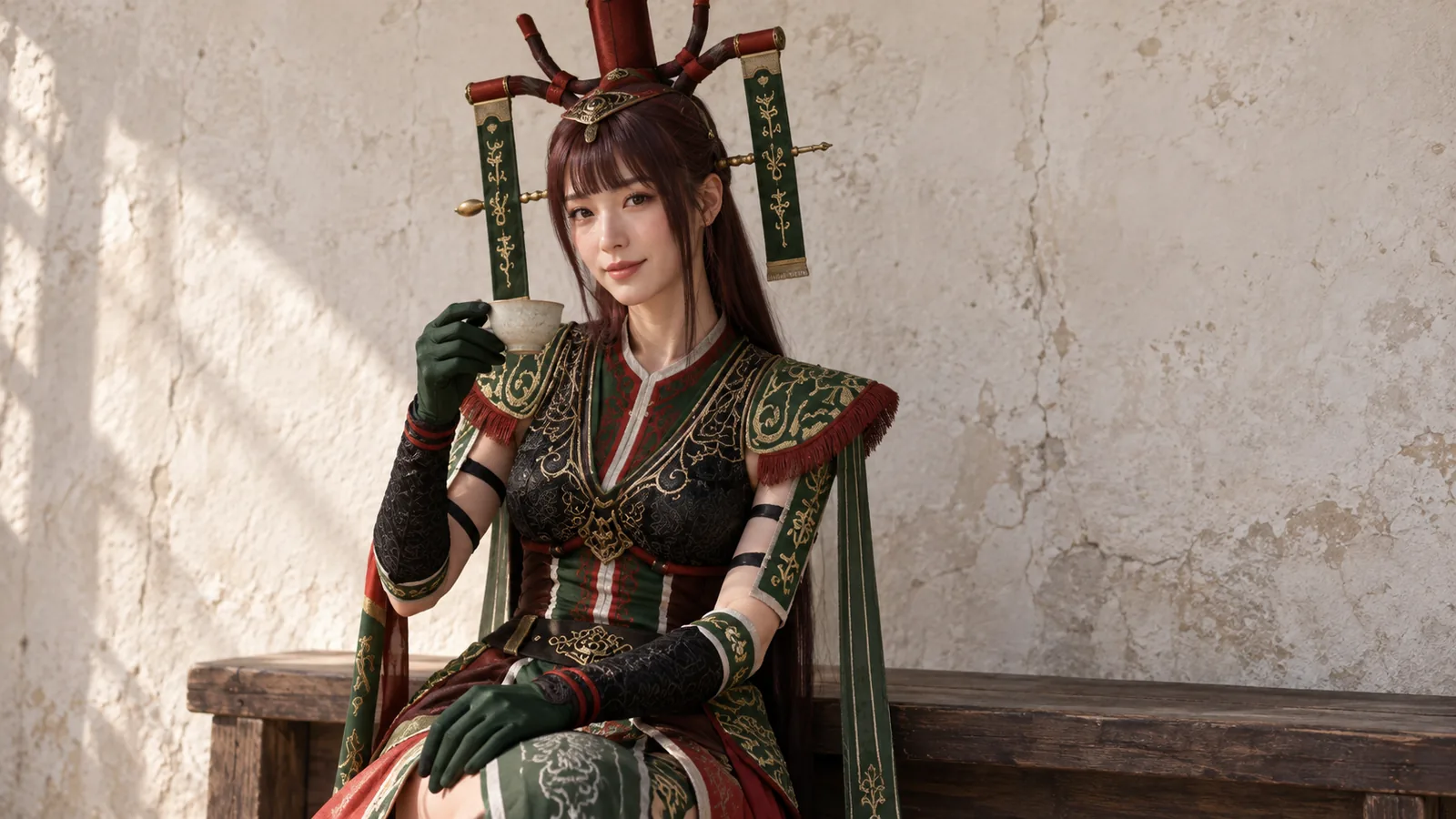
The tea-break scene uses the same red-and-green game-inspired G42 outfit in an imagined quiet moment. A plain cup and bench give the garment something ordinary to move around. The historical discussion makes room for everyday clothing, but the picture is neither an old photograph nor evidence that this particular fantasy headdress was worn for tea.
A small spelling clue from May 2006
Tony Chou’s Merchant FAQ, marked updated 26 May 2006 on GameFAQs, lists a G42 MyungJoo set under Magician merchant Won-Sung at Temporary Fort. Its spelling is CaeChangEau. We retain that distinction when citing the record; the present official guide and recovered configuration use DaeChangEau. The earlier list is evidence of period equipment vocabulary, not a reason to silently rewrite its text. [5]
Small inconsistencies are part of reading an old game through surviving records. They ask us to compare the item, merchant and grade instead of assuming one spelling tells the whole story. A dated player guide and a current official catalogue answer different questions. Neither alone proves when every later variation first appeared.
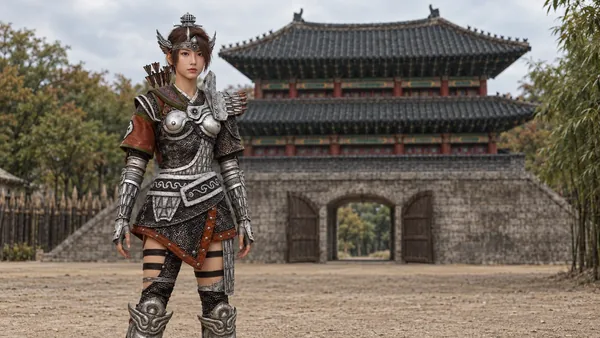
This is also why the three original classes matter to the pictures. The Archer armour, male Knight and female Magician remain distinct across this series. Their equipment should help the reader recognise the game before any historical explanation begins.
The blue variation keeps its own identity
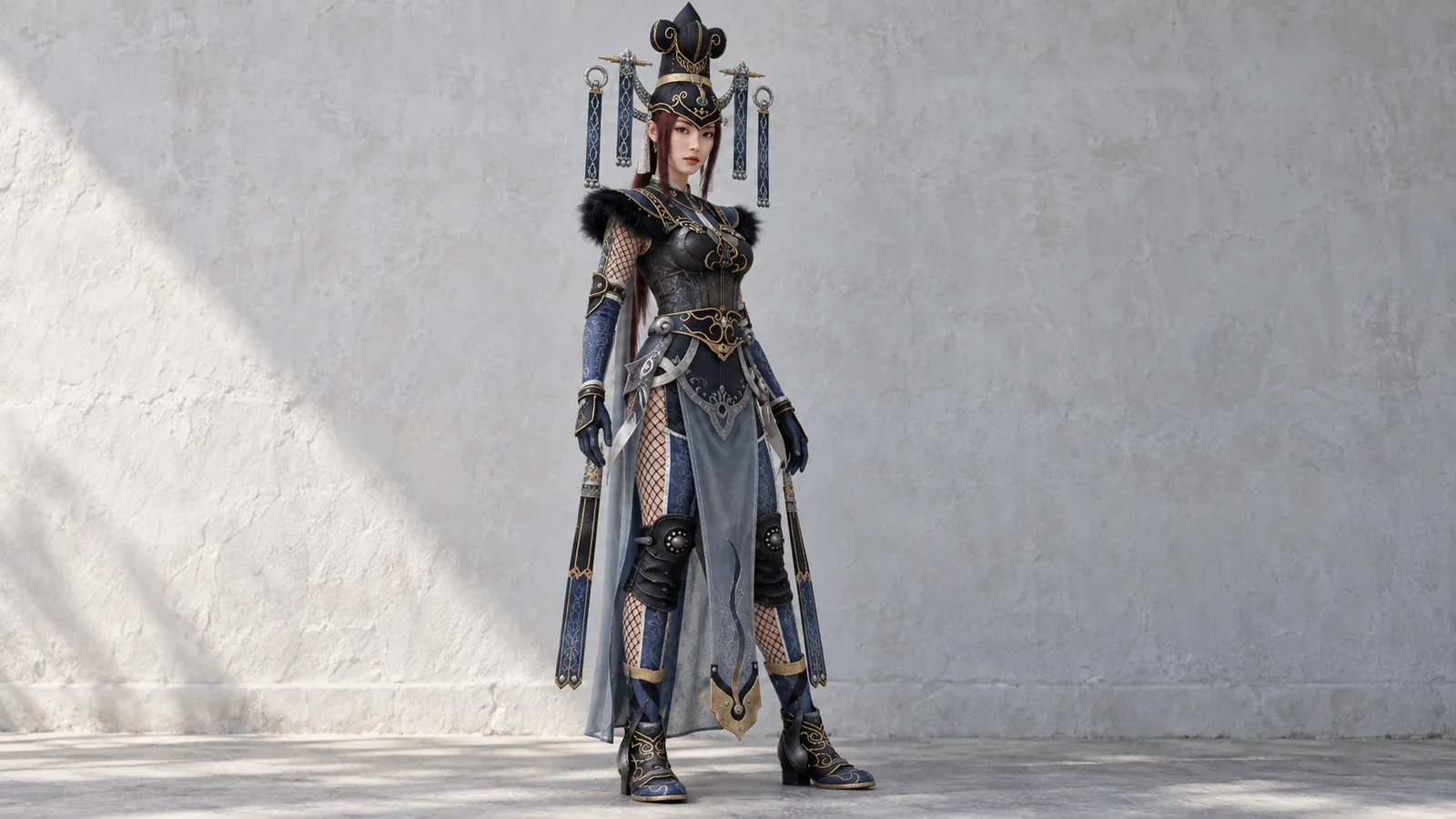
The final photograph changes to the G46 BeeDan reference: blue and black, gold edging, dark fur, mesh sections and four long hanging headpiece panels. The red-and-green MyungJoo design has two principal green panels. Those visible differences belong to the source outfits. They should survive the move from a game model to a human performer.
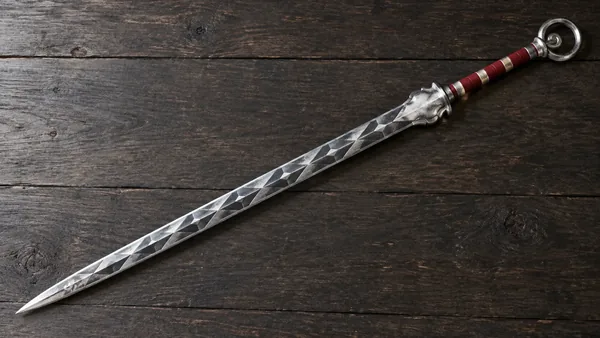
All four images are AI-generated live-action interpretations. The costume references guide their recognisable shapes and colours; faces, poses, textile surfaces and the tea break are imagined. They illustrate the game’s wardrobe. The linked cultural entries explain the historical garments separately.
If a headpiece or colour takes you back to a particular character, add the memory below. Tell us which set you wore and when. A photograph can give the familiar shape a new physical presence; the people who wore it through years of play supply the part no image can reconstruct.
Sources & image credits
Research checked on 16 October 2026. Cultural scholarship, a dated player guide and current game records are identified separately. Photographic scenes are new AI interpretations of game references. Museum objects can be viewed through the collection links; their photographs are not reproduced here.
- Magician armour · official KalOnline guideINIXSOFT / KalOnlineCurrent names and grades checked 16 October 2026. Historical robe terminology is an editorial linguistic comparison, not a verified statement by the game’s designers.
- Daechang-ui (대창의) · Dictionary of Korean Historical CostumesDictionary of Korean Historical Costumes · Academy of Korean Studies hosted editionHistorical adult male dress is discussed separately from the female Magician costume. The dictionary title uses 大昌衣; related historical records also use 大氅衣.
- Crane (두루미) · clothing and cultural associationsKim Hun-su · Encyclopedia of Korean Culture, Academy of Korean Studies · 2023-02-07Only the entry’s cultural and clothing discussion is used here.
- Sochangui (소창의 / 小氅衣)Hong Na-young · Encyclopedia of Korean Culture, Academy of Korean Studies · 2026-06-24Authored in 1995; revised 24 June 2026. The historical uses and textiles do not establish a game crafting recipe.
- Kal Online Merchant FAQ, version 3.0Tony Chou · GameFAQs, listed under Brave_Song · 2006-05-26Page marked updated 26 May 2006. A contemporary player-authored record, not an official price guarantee. Its historical spelling CaeChangEau is identified where relevant.