
The place you could find without thinking
There are game towns you remember as a list of services, and others you remember almost with your feet. A particular stretch of open ground, a roofline and the next turn were enough. Narootuh can belong to that second kind of memory. You did not have to study its name before you learned where to go when your inventory was full.
Looking at the word now opens a small linguistic door. Narootuh closely resembles the Korean naruteo, 나루터. The resemblance gives us a useful cultural reading, but it is not a newly found developer explanation. We have not verified an original naming note that establishes why this particular English spelling was selected.
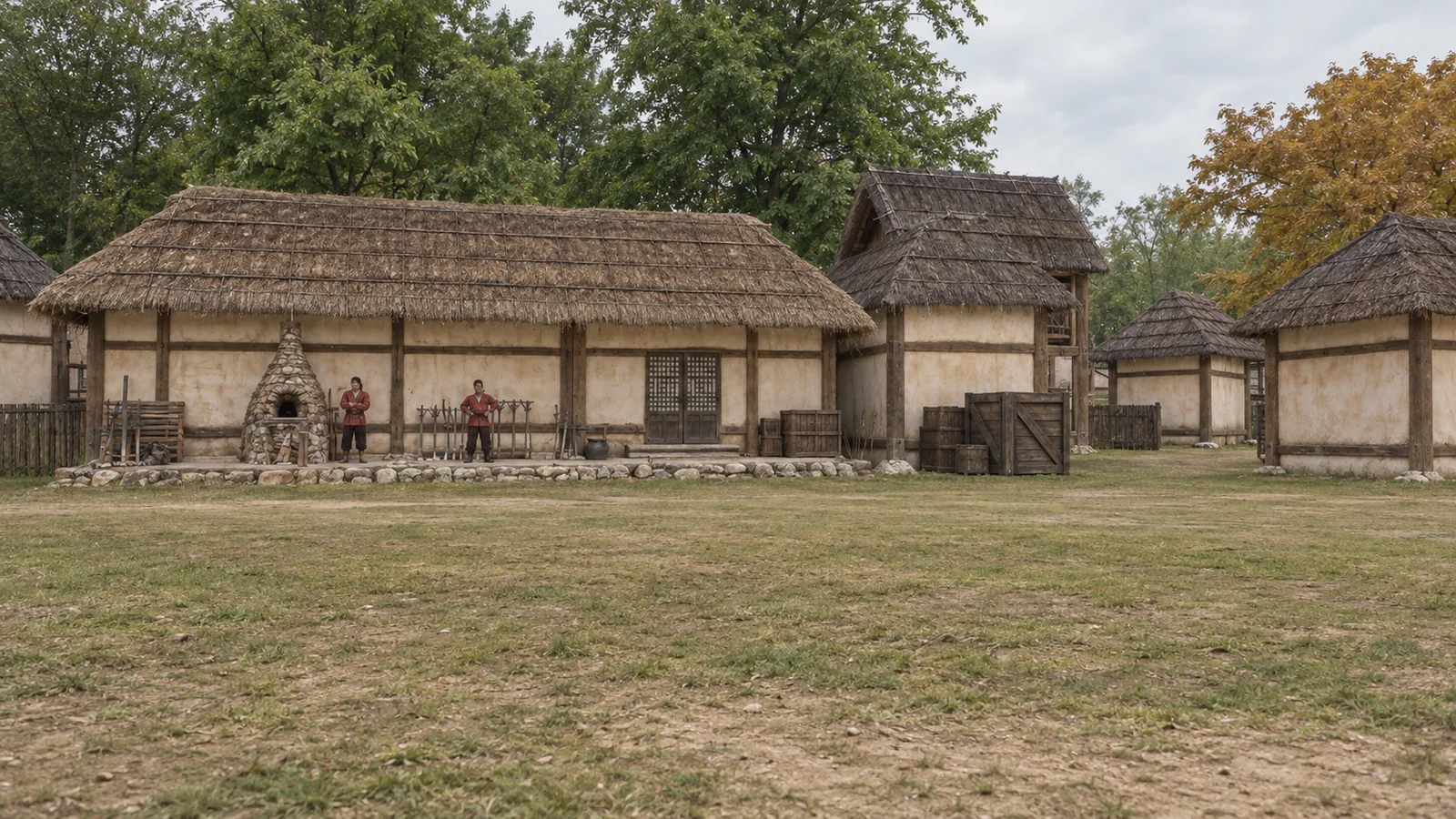
The village photographs begin with game screenshots and native layout references. They retain the modest buildings and open ground rather than replacing the town with an elaborate historical city. The remembered place deserves to remain recognisable before we add a story to its name.
Naruteo is a landing, not a lake
The National Institute of Korean Language distinguishes naru, the place where boats cross a river, stream or narrow stretch of sea, from naruteo, the place where a ferry arrives and leaves. In that explanation, the crossing and the landing are related, but they are not identical. Ferry landing is therefore a more precise starting point than treating the word as a general name for water. [1]
A separate answer by the institute explains naruteo as a compound of naru and teo, two nouns. That helps make the word less opaque to an English-speaking player: a place-name-like sound can carry an ordinary description of a crossing place. It does not identify KalOnline’s village with any particular real settlement in Korea. [2]
Crucially, this reading supplies no reason to put a lake in the middle of the game town. The meaning of a name cannot override the positions of the buildings, paths and landmarks in the original references. A linguistic comparison is not a new map design.
The game supplies its own people and purposes
The current official NPC guide calls the location Narootuh village and lists Boatman Gwang-Chun, Fishing Grounds Managers, merchants, guards and other inhabitants. That is a meaningful connection with travel and fishing in the present guide. Its list also includes later classes and systems, so it cannot be copied wholesale into a reconstruction of the 2004–2007 town. [3]
The more cautious conclusion is still interesting: the word suggests a landing, and the game’s current village catalogue contains a boatman. These are two pieces of evidence that fit together. They do not establish a precise real-world location, an original developer intention or a date for every NPC.
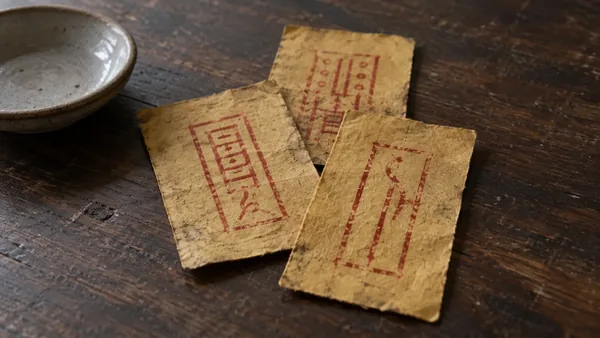
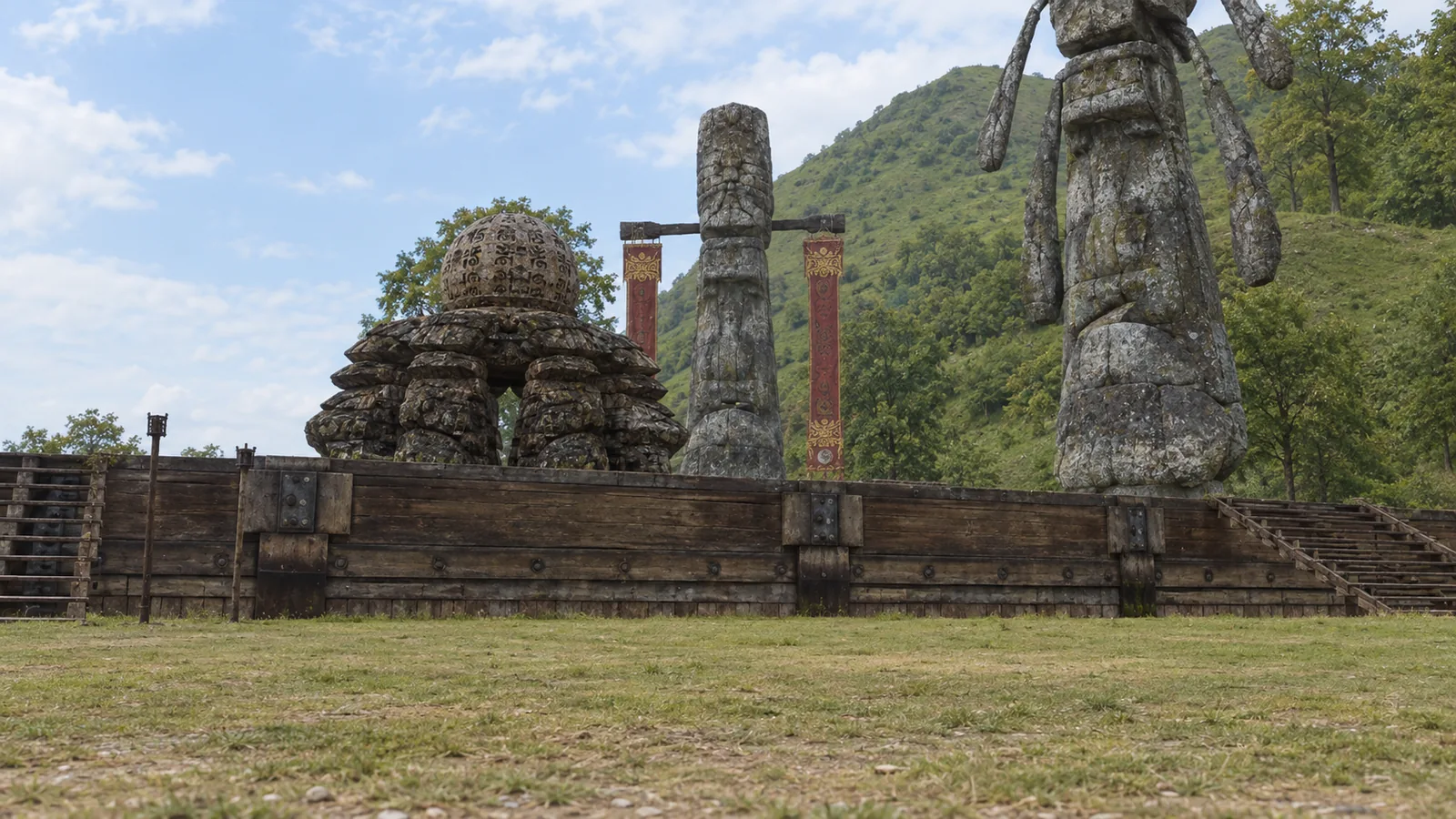
The same care applies to the stone monuments in the second photograph. Their shapes and arrangement come from the game reference. We do not identify them as specific Korean archaeological statues merely because they look old. Their historical identity would need evidence of its own.
The small architecture carries the memory
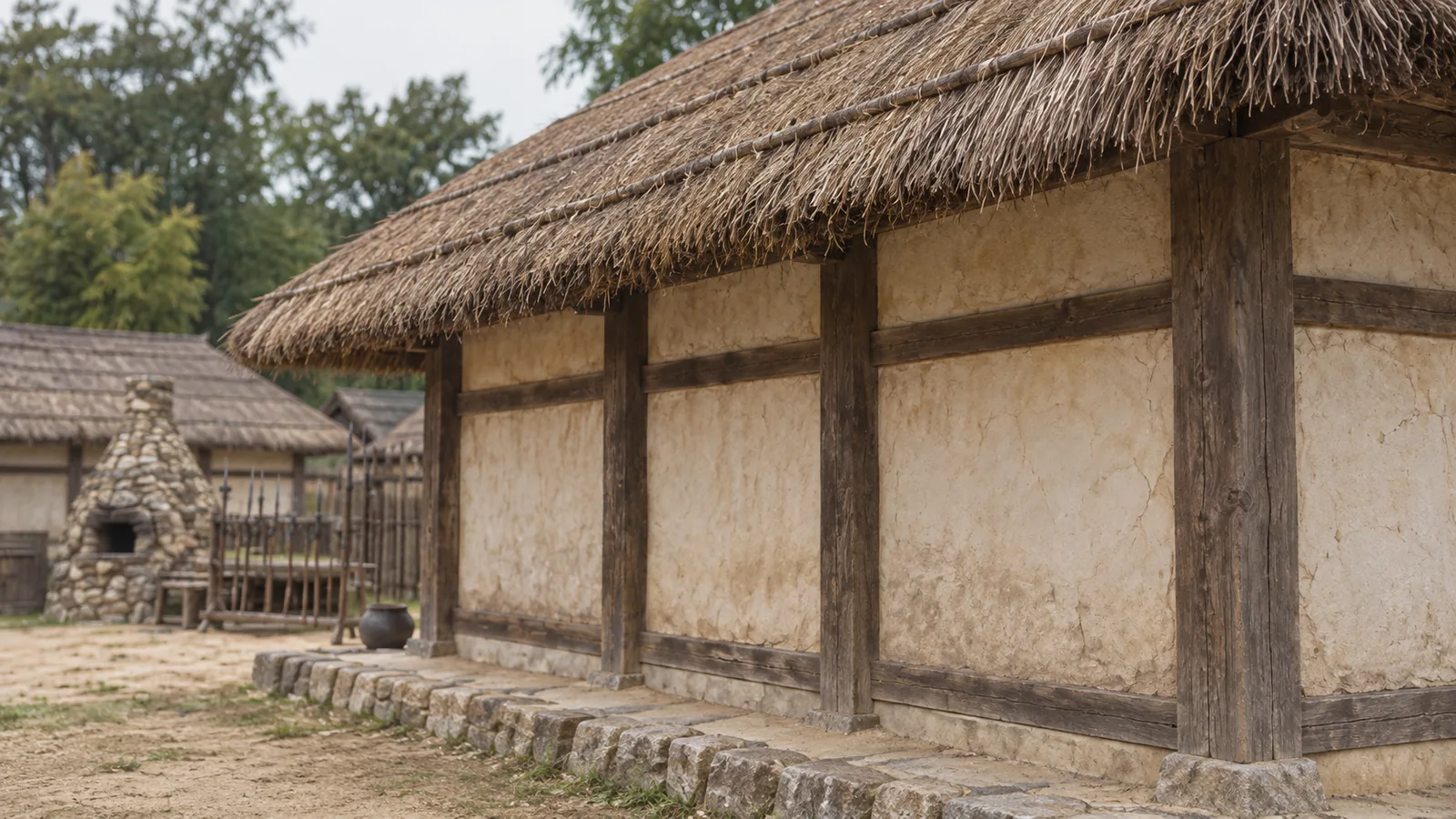
The close image returns to thatch, timber and pale plaster. These are visible material cues in the supplied village screenshot, not a claim that every building follows the construction rules of one historical period. Making them tangible is an artistic translation: straw becomes individual fibres, a painted wall becomes an imperfect surface and a dark roof edge has thickness.
A good translation also respects the empty parts. An open patch of ground may be where a player remembers stopping, even if there is little in it to impress a new visitor. Filling it with market stalls, lanterns or ornamental bridges would remove some of the evidence that it is the same place.
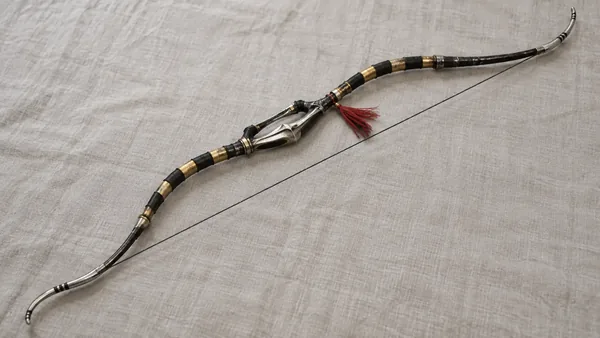
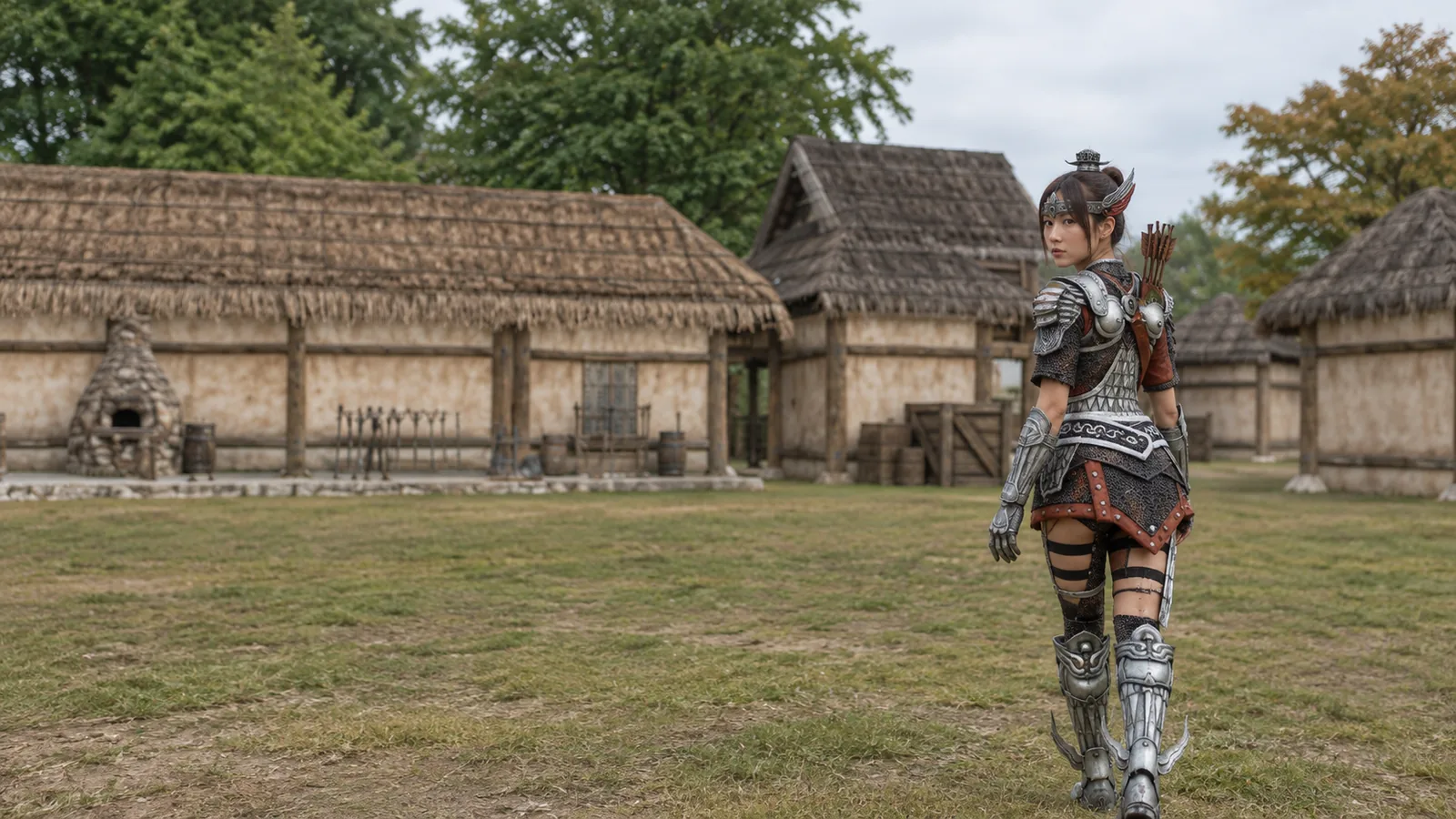
The first photograph leaves the central avatar out so the buildings can be read clearly. The last brings an Archer back into the scene using a separately referenced outfit. One view studies the place; the other imagines an ordinary return to it. Neither is presented as an original game capture.
An ordinary town in an old player’s record
Tony Chou’s May 2006 merchant guide begins with Narootuh and its shops. It preserves the village as a practical player destination. [4]
That is the scale on which much of a shared game world survives: where supplies came from, where someone waited and which name you typed when the party became separated. A town does not need to be the centre of a heroic event to become important. Repeated visits give it a place in a player’s life.
The historical rankings preserve another part of that world: names with dates and servers attached. They can help place a memory in time, but they cannot reveal where a character stood on a particular evening. A new image should not quietly supply that missing evidence.
What did returning to Narootuh mean to you?
All four pictures are new AI-generated photographic interpretations. The village and monument screenshots guide the visible layout; physical materials, light and the Archer’s movement are imagined. The name is explored through Korean-language sources, while the town remains a location in a fictional game.
Perhaps you remember the first time you could afford a new piece of equipment here, or the player who always seemed to stand in the same place. Those memories can add a human map to the visible one. Include the server, approximate year and any old screenshot you still have when sharing a correction or recollection.
A place can become more familiar when we understand its name. It need not become grander, busier or geographically different. Sometimes the most useful discovery is a small ordinary word hiding inside a name we have been saying for years.
Sources & image credits
Research checked on 16 October 2026. Cultural scholarship, a dated player guide and current game records are identified separately. Photographic scenes are new AI interpretations of game references. Museum objects can be viewed through the collection links; their photographs are not reproduced here.
- The difference between naru and naruteoNational Institute of Korean Language · 2020-01-16Dictionary-based language explanation; not a KalOnline developer naming statement.
- Naruteo: a compound of naru and teoOnline Korean Language Consultation · National Institute of Korean Language · 2024-10-30
- Narootuh village · official NPC guideINIXSOFT / KalOnlineCurrent NPC catalogue checked 16 October 2026, including later additions. Its full list is not assigned to the 2004–2007 version. Native village screenshots/layouts were private visual references.
- Kal Online Merchant FAQ, version 3.0Tony Chou · GameFAQs, listed under Brave_Song · 2006-05-26Page marked updated 26 May 2006. A contemporary player-authored record, not an official price guarantee. Its historical spelling CaeChangEau is identified where relevant.
- Archer armour · official KalOnline guideINIXSOFT / KalOnlineCurrent guide checked on 16 October 2026 for item names and grades; current combat statistics do not establish the 2006 balance. Native game renders were private design references for new artwork.